
My blog has something to tell you Rotating Header Image

politics

Leeds Tube map updated

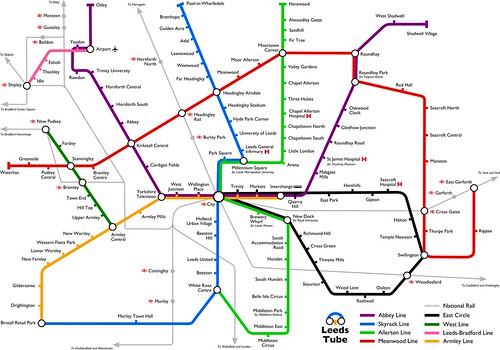
My Leeds Tube map was an unexpected hit on Twitter, and I even ended up being in the Yorkshire Evening Post!

I also received some feedback from people who would like to see my fantasy tube support more of the population centres in Leeds. Some of the feedback was very constructive so I’ve taken the time to update it with two new lines, the East Circle, connecting settlements in East Leeds, and the West Line that connects Armley and Bramley with the rail network.

Leeds Tube map updated

Click to view a larger version on Flickr.

I also updated the Google Map to show the real1 locations of these stations.


View Leeds Tube in a larger map

As before, this is released under an attribution-noncommercial licence, so feel free to print it out or use it yourself for things as long as you credit me and don’t make any money from it. And the SVG source is available too.

If you have any comments on the update, leave them below or on Twitter!

{lang: 'en-GB'}
  1. Well, as real as they’ll ever be. []

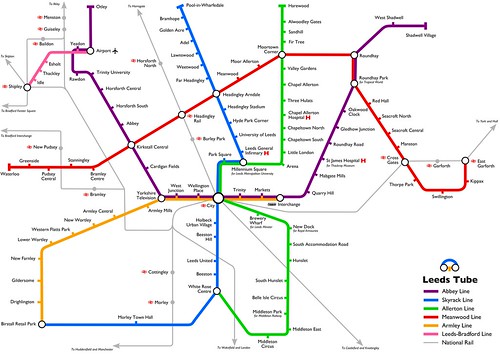
Leeds Tube map

Hello visitors! See this update!

Leeds is an amazing city: my favourite place I’ve ever lived. But one thing it does really badly is public transport. We have one massive railway station in the centre of town and then (with a few exceptions) the rest of the city is accessible by unreliable, expensive and unpleasant First buses.

As I have got to know the city better, one thing has kept coming back to me: wouldn’t it be amazing if Leeds had a metro system? So I imagined an alternate reality where the city I love has an amazing and reliable underground railway called Leeds Tube.

Leeds Tube Map

Click to view a larger version on Flickr.

Leeds Tube has several lines that connect the major population centres and attractions, including the Meanwood Line which connects the various settlements in North Leeds that have a very close relationship with one another and the Leeds-Bradford Line that connects the airport with Shipley for onward rail connections to Bradford and its suburbs.

I drew a fancy tube map1 (above) and I also plotted roughly where I think the stations would be on a Google Map (below):


View Leeds Tube in a larger map

How would your life be changed if Leeds had a Tube? What journeys would it help you with? Would you put the stations or lines somewhere else if you were designing it? Let me know in the comments!

Edit: Following some feedback on Twitter, I’ve made a couple of changes to the Beeston area, which I’d been thinking about before but didn’t make, for some reason.

{lang: 'en-GB'}
  1. I’ve released the tube map under an attribution-noncommercial licence, so feel free to print it out or use it yourself for things as long as you credit me and don’t make any money from it. If you’re interested, the SVG source is available too. []

Lords Reform: Time for a Senate of the modern age?

The House of Lords is a bag of balls. We know this – you’d be hard-pressed to find anyone other than a foaming traditionalist who believes that having almost two-thirds of our country’s lawmakers being appointed, rather than elected, is a good idea.

The recent news about the latest bill for Lords Reform  — the latest in a line of small-scale tweaks — is the most exciting yet because it promises a large proportion of the seats to be democratically elected.

But do we need another set of politicians elected the same way as the Commons? Will the public even understand why they’re voting for two different representatives? Will they care? It’s hard enough to get people to turn out for elections when they’re only voting for one.

In many countries such as the USA and Ireland, the Upper House is called the Senate. This name comes from the Latin senex, which translates into English as elder. In modern usage, an elder is someone who has acquired deep knowledge of a subject or community, perhaps due to age (the historical definition) or perhaps just due to extraordinary experience.

The primary purpose of the Upper House in most bicameral systems, including the UK, is to apply specialist knowledge to bills and policy debated in the Lower House. Indeed, many of the Lords are specifically appointed because of their knowledge of law, religion or (to a lesser extent) subjects like science and history. (Many of them are currently not, also.)

We are a complicated mixed bag of a country, and a lot of the things that really matter in this modern world, like technology1, disability and immigration are not represented adequately in our Parliament. Reform is an opportunity to address this!

And here is how we could distinguish the Commons from the Lords in a fully democratized Parliament: representatives in the Lords should only be elected by the people they represent. For example, you could have Healthcare Lords who are elected only by healthcare professionals, Disability Lords who are only elected by disabled people, Immigration Lords who are only elected by immigrants, and so forth.

This isn’t de-voicing the rest of the populace on those issues — the Commons are still elected the same way, and they’re the ones who make the laws — it’s just delivering the power to slow bills and the power to suggest amendments into the hands of the people they affect hardest. One wouldn’t have to be disabled to be a Disability Lord, but one would have to be elected by disabled people.

Obviously, this would be a nightmare to implement (how do you decide if someone is Caribbean enough to vote for the Caribbean Lord or disabled enough to vote for the Disability Lord?) but it’s an interesting thought experiment.

What subjects or communities would you want to be represented by their own Lords?

Here are some thoughts I’ve had:

  • Immigration Lords
  • Disability Lords
  • Women’s Lords (a post that will hopefully one day be unnecessary, but right now women are still a marginalized group in politics)
  • LGBT Lords
  • Unemployment/low-income Lords
  • Family Lords
  • Lords of specific “British International” subcultures:
    • Caribbean Lords
    • Chinese Lords
    • Indian Lords
    • etc.
  • Lords of specific religious communities (we have some already):
    • Christian Lords
    • Muslim Lords
    • Sikh Lords
    • etc.
  • Lords of specific industries:
    • Science Lords
    • Healthcare Lords
    • Technology Lords
    • Education Lords
    • Environment Lords
    • Economy Lords
    • etc.
  • Media Lords
  • Sports Lords
  • Military Lords (dare we?)
  • Political Lords (elected by MPs and Councillors? Is that crazy?)
  • Law Lords (we have these already, but these would be elected ones)
  • What else?
{lang: 'en-GB'}
  1. Does anyone in the industry think an opt-in porn block for ISPs is a sensible or ethical idea? []

Dr Richard Stallman — For a Free Digital Society

You know what they say about coming face to face with your heroes. It’s all true; at least in this case.

As a die-hard ultra-liberal by persuasion and a software engineer by trade, it stands to reason that my ideologies lie somewhere in the free software movement. Imagine my delight when I discovered that none other than the movement’s founder, Dr Richard Stallman, was coming to give a lecture to the people of Leeds.

Dr Stallman’s lecture title was “For a Free Digital Society” and the subject matter was about protecting our freedom in a world where things like surveillance and restrictions on ownership of content are easy for governments and megacorps to implement. Great: so far, so good. Those are things I’m worried about too and I’m looking forward to some solutions…

Except what comes out of Dr Stallman’s mouth doesn’t sound like well-reasoned answers to difficult political questions. It sounds like opinionated, poorly-researched, accusatory diatribe.

He begins by convincing us he’s a member of the tinfoil hat brigade (I don’t have a cellular phone because they’re tracking me!) He’s right, of course, but his argument comes across simply as “freedom beats convenience in all cases” with no room for manoeuvrability. One wonders how he got to the UK to deliver this lecture without first giving his fingerprints to the US government in exchange for a passport.

He goes on to attack those of us who make a living from commercial software or SaaS platforms, saying our employers are pure evil and working for them is unethical. His solution to how people should continue making a living is “almost all software development is for individual customers so work for a company that does this.”

I personally believe in software freedom and I’m aware of the questionable practices of commercial software developers but I see my job as a necessary evil in the pre-free world we live in and I like to think I’m making a difference from the inside.

I also respect the rights of other people to hold opposing economic views to me without resorting to tarring them all with the same brush; something Dr Stallman has no trouble doing.

Later, he concludes that, since the music publishing industry is corrupt and restricting freedom, everyone should start breaking their country’s copyright laws instead of challenging them democratically.

The really frustrating thing about all this is that I concur with most, if not all, of Dr Stallman’s fears about restriction of freedom — having read sensible reasoned arguments in the past — but a whole cross-section of his audience (I discover from talking to them afterwards) had not done so and left the lecture completely jaded by the ideas due to Dr Stallman’s “Batshit Messiah” persona.

Dr Stallman is not representative of the movement he created, thankfully, and I’d encourage anyone who attended his lecture to take the time to read more reasonable literature on the subject by the FSF and also wider-reaching groups like the Electronic Frontier Foundation and Liberty.

{lang: 'en-GB'}

“Gay” quarter

There’s a bit of buzz amongst the Leeds Twitterati about a proposal to designate a region of Leeds city centre as the “gay quarter”.

Aside from the interesting discussion about politics and about whether singling out an area in this way is a good thing, which is all very interesting, I’d like to draw attention to the proposed name itself.

Inclusive, tolerant, regions of cities in this country have historically found themselves labelled with the adjective gay, but in my opinion this is a dangerous and divisive anachronism.

The term gay, when applied to a person, refers to a specific type of marginalized sexual minority: specifically, someone who is exclusively or primarily homosexual. In modern times, the term LGBT is preferred as more inclusive, although this in itself fails to include so many people.

On top of that, most so-called “gay bars” are very welcoming of members of the cis/heterosexual majority as long as those people are welcoming back.

Sackville in central Manchester became known as the “Gay Village” in the 1980s but since the turn of the century it has gradually become simply the “Village”, which is a great way to indicate that there’s no good term that includes everyone.1 Similarly, most Pride events are now simply known as “Pride”.

If Leeds does name this part of town, let’s please choose a name that’s as inclusive as possible, instead of labelling it as purely the domain of one specific sexual orientation.


{lang: 'en-GB'}
  1. No, I’m not a fan of LGBTTIQQ2SA. []

Legislating morality

In the aftermath of the horrendous wave of crime that spread across many cities in Britain last week, we are starting to see something even more despicable: the ever-present threat of “morality legislation”.

I know lots of people have written about the government’s response to the riots and I’m a little nervous about joining the crowd, but I feel I need to add my voice to the clamour.

In a speech on 10th August, our nation’s leader said this:

The problem with that is a complete lack of responsibility.

A lack of proper parenting, a lack of proper upbringing, a lack of proper ethics, a lack of proper morals.

That is what we need to change.

Mr Cameron, I say this: How dare you?

How dare you dictate to me or the other people in my country what is proper about parenting, upbringing, ethics or morals?

We live in a free society, and our freedom to bring our children up in the way we choose and our freedom to choose our own ethical and spiritual path is guaranteed by law. [Articles 8 and 9 of the ECHR]

Those societies where morality and ethics are legislated are generally the ones that have the biggest unrest amongst their local populations. Just look at what’s happening in the Arab world at the moment.

I agree that the crimes committed last week were dreadful, so let’s look at what we can do to prevent them from happening again. Maybe you want to start by looking at why people think that they have nothing to lose by turning to crime… is it because they have nothing to lose, as a result of the failure of the last two governments to look after the whole of our population?

Rant over.

(Full disclosure: Although I am extremely unhappy with many of the attitudes of the current coalition government, I am still – and proudly – a card-carrying Liberal Democrat. More on this in a later blog post.)

{lang: 'en-GB'}

The spectre of Section 28

You may have heard today that a school has successfully destroyed plans for a new opera, Beached, written by Lee Hall of Billy Elliot fame.

Their claim is that the lead character being clearly homosexual is “inappropriate” for the 300 primary-age children taking part in the performance, and organizers Opera North have supported the school in this decision.

Regular readers of my blog (hello!) will probably agree with me that this is, of course, an obnoxious bigoted viewpoint that the school is perpetuating, but it got me thinking about the legality and, in particular, the ghost of Section 28.

Section 28 of the Local Government Act 1988 was a piece of Conservative-era legislation created in response to a bit of Daily Mail hatred about a book called Jenny Lives with Eric and Martin that was found in a school library in London. The legislation forbade state schools from “promoting the teaching [...] of the acceptability of homosexuality as a pretended family relationship”.

This bottle of discriminatory vitriol stayed on the British law books for 15 years, even facing considerable defeat during the early years of the New Labour government at the turn of the century.

Overturning the legislation, however, merely allows schools to teach children that homosexuality is normal. It does not require them to do this. And, as evidenced by today’s events, it even allows schools to continue to kick up a fuss when kids are exposed to homosexuality. Individual councils are even free to draft their own local Section 28.

Do we really want kids growing up in an environment where normal, healthy sexual orientation is hidden from them or swept under the carpet like a dirty secret? Or, worse, having it deemed “inappropriate” in a big song and dance? What are those kids going to be like when they grow up and have to face the reality that some of their colleagues will be gay, some of their friends will be gay, they themselves might be gay?

It’s time we had an opposing legislation to Section 28 and we vanquish its spectre for good!

{lang: 'en-GB'}

Towards a Federal Europe

When asked for my national identity on the 2011 Census form, I put European. Why? Because I am not proud to be a member of this state, specifically, but I am very proud to be a citizen of Europe.

Europe, historically, has been at the forefront of technological and social evolution. Many of the world’s most important discoveries and inventions originated here, and many of our member states had huge empires to their name in the days when that was the done thing. But most importantly to me, we champion civil liberties before anywhere else. The abolition of the death penalty throughout the Council of Europe (of which the EU is a subset) and the advancement of LGBT rights are the two that come to mind immediately.

If the EU is treated as a single federal nation, it will become the richest in the world (32% of Earth’s GDP), while holding onto the third largest population (half a billion people, or 7% of Earth). In short, we’d be unstoppable.

The European Union already has a lot in common with federal nations like the United States, India and (recursively) Germany. We have a central parliament and high court which, like the United States, only has jurisdiction over certain aspects of the law. We have a single currency although many states have not yet adopted it. And we have some forms of common home policymaking (the European Commission) and foreign policy (CSDP and Eurofor).

So what’s missing? Why isn’t Europe considered a nation right now? Primarily this is because the individual states refuse to give up their sovereignty — something which will be very hard to pry away from many of them (especially the UK) with their long-standing traditions of empire-building and patriotism. Also required would be some form of written or unwritten constitution (which is an ongoing battle) and a single taxation system contributing to a federal exchequer. I don’t think these two are completely unrealistic long-term goals.

As a reader you can probably think of several disadvantages and I’d like to share my opinions on several of those:

Culture and Language

We’re all from different cultures and speak different languages, say the patriots. Well, that’s true, but is that such an oddity in a large nation? In India, there are hundreds of languages, of which 29 have more than a million native speakers each! Some states in Europe such as Belgium and Malta already cope just fine with multiple languages being spoken natively. And, closer to home, you’d hardly expect too many similarities between the culture of Burnley and the culture of Brighton. Culturally speaking, on a global scale most European states are pretty aligned.

Holes in the land

Norway, Switzerland and the microstates have elected to stay out of the Union, leaving holes in the land. This is not unheard of either: San Marino and the Vatican are already enclosed by Italy. Lesotho is surrounded by South Africa. And if tribal sovereignty is not ignored, the United States is full of holes!

We’ve got a Queen

Well that is an interesting one. Several of the states of Europe do indeed have their own monarchs. In a federation this too is not unprecedented. The United Arab Emirates is a federation of seven states, each with its own monarch. There is no reason to sacrifice a monarchy for the sake of federation.

Foreign policy

Should we let the European bigwigs decide what we do or don’t do with regard to other nations? Two words: Tony. Blair. Enough said?

The Euro has failed

A single nation would need a single currency, and the Euro has not done so well in recent times, thanks to the market crashes in Greece and Ireland. But I say we would all be helping each other out in these situations regardless, because that’s what allies do. Why not make it official and give us no choice but to support the poorer states with money from the rich? After all, it might be our turn in 50 years’ time.

Europe is a continent

Actually, Europe is described as a continent purely because of our cultural heritage, so this is a sign that we should be better united. There is no geological basis for the European continent at all. Oh, and by the way, Australia and India each make up the bulk of their respective tectonic plates.

I think I’m very much a dreamer in this regard, and I don’t think we’ll see a truly United Europe in my lifetime, but I’m hoping the progress is towards a Federal Europe and not away from it.

Next stop: United Earth!

{lang: 'en-GB'}

Fascism, immigration and the English language

The BNP and other right-wing groups I loosely term fascist (although some may, legitimately, disagree with my use of the term) are always talking about making sure Britain stays “British”, and keeping its population “indigenous” so that our culture is not polluted by those of the immigrant nations.

Here’s a representative quote from the BNP web site1:

Immigration is out of control. Britain’s population is now over 60 million and rising, solely due to immigration. Not only is Britain increasingly overcrowded, but the fact is that a country is the product of its people and if you change the people you inevitably change the nature of the country.

We want Britain to remain – or return to – the way it has traditionally been. We accept that Britain always will have ethnic minorities and have no problem with this as long as they remain minorities and do not change nor seek to change the fundamental culture and identity of the indigenous peoples of the British Isles.

Now, without being too pedantic about the rest of this, let’s focus on the word indigenous. Wikipedia defines this well:

Indigenous peoples are ethnic groups who are native to a land or region, especially before the arrival and intrusion of a foreign and possibly dominating culture.

Well, I guess the race with the biggest claim to that is the Celts. They arrived here in the Bronze Age, around 1200 BC, and thrived throughout the Iron Age and throughout the Roman subjugation of England and Wales. They spoke a group of languages known as British, which survive in the modern forms of Irish, Scottish Gaelic, Welsh and Cornish.

However, I believe Mr Griffin is also referring to the aforementioned “foreign and possibly dominating culture”: the Anglo-Saxons. Anglo-Saxons make up by far the largest ethnic group in Britain, and indeed Mr Griffin himself is one. But they are far from indigenous to these islands. The first Anglo-Saxons arrived here in Britain in the early 5th century, as mercenaries hired by the failing Roman occupiers. In 442 AD they mutinied and eventually took the land for themselves at the turn of the 6th century.

In case you missed this: even the Romans have more of a claim to being the indigenous peoples of this island than the Anglo-Saxons!

The Word Tree at Ellis Island Museum of Immigration, showcasing words brought into American English by immigrants and natives

The Anglo-Saxons brought with them an exciting new language, called English. What is exciting about English is that it is a true language of immigrants. It has shaped itself repeatedly as it has been used in more and more parts of the world. It has taken concepts and words from virtually every culture on the Earth. English has been adopted by so many people as the language of international commerce and travel, thanks to its willingness to open up to foreign influences.

The English we speak today still has broadly the same grammar as its closest relatives, the Germanic languages, but a staggering 58% of the English lexicon is borrowed from Latin and French alone, neither of which have even made a dent in the other Germanic languages.

As an example of how quickly English allows itself to change and adapt to foreign influences, here’s the opening of Beowulf, an English-language poem written less time ago than the time between the arrival of the Celts and the arrival of the Anglo-Saxons:

Hwæt! W? G?r?Dena in ge?r?dagum
þ?od?cyninga þrym gefr?non,
h? þ? æðelingas ellen fremedon.
Oft Scyld Sc?fing sceaðena þr?atum,
monegum m?gðum meodo?setla oft?ah.
Egsode eorl, syððan ?rest wearð
f?a?sceaft funden: h? þæs fr?fre geb?d,
w?ox under wolcnum, weorð?myndum ð?h,
oð þæt him ?ghwylc þ?ra ymb?sittendra
ofer hron?r?de h?ran scolde,
gomban gyldan: þæt wæs g?d cyning!

Know what it’s on about? If you do, you beat me!

So, for fun, let’s pick languages from some ethnic groups commonly picked on by the BNP and its ilk, and have a think about how Mr Griffin and co. would get along without some of these apparently very English words:

  • Arabic: admiral, coffee, guitar, lemon, magazine, orange, sofa, zero.
  • Chinese: ketchup, silk, tea, tycoon.
  • Hebrew2: apron, cannon, cider, map, sapphire.
  • Hindi/Urdu: bungalow, jungle, pyjamas, shampoo, thug.
  • Persian/Farsi: cash, magic, peach, tiger.
  • Slavic languages: bridge (the game), robot, vampire.
  • Turkish: bugger, doodle, kiosk, yoghurt.

And, as an interesting aside, loanwords from the indigenous languages of these islands are extremely rare in our language. 3

{lang: 'en-GB'}
  1. I hesitate to link for fear of increasing their Google PageRank. []
  2. Yes, yes, I know the BNP has explicitly stated many times it’s not anti-Semitic, but many right-wing groups are! []
  3. Although it is believed that penguin comes from the Welsh for “white head”. Yes, penguins have black heads. []

NHS dentists; or, how I learned to start worrying and hate my teeth

I’ve just come back from having the second of two fillings put in at my new dentist. Why did I need two fillings, you ask? Well, this dentist is the first dentist I’d visited in over ten years.

Why did I stay away for so long? I’m not really the squeamish type: I don’t have a problem with jabs, blood tests and so forth… I went ahead with a circumcision given an on-the-spot choice about having it that day, for heaven’s sake. No, I stayed away because the NHS dental system itself set the ball rolling on the cumulative fear process.

The cumulative fear process, as I call it, is that process that occurs when you put something off because you’re scared of it, but the longer you put it off, the scarier it becomes, which of course makes it harder to go through with.

I wasn’t scared in the beginning, though. I was merely baffled and intimidated by the system. That was enough to keep me away long enough to start rolling up the katamari of fear.

The thing is: NHS dentistry costs money, and it is only accessible to a lucky few.

More or less everything else on the NHS costs the patient nothing. This even includes scientifically unproven so-called complementary therapies like acupuncture and homeopathy. Not so dentistry: working adults over the age of 18 and students over the age of 19 are asked to make a contribution of normally £47 (but possibly £204) for any treatment, and £17 for a checkup or hygiene appointment.

As a student at the age of 19 that’s not a fun prospect. We’re not only mostly not earning at that age, we’re also living off borrowed money, and very little of that. £47 back then would have been a week’s rent and still is for many students.

But that’s only a small part of the problem most people face when they become students. Many of us chose to obey the so-called “hundred-mile rule”1 which meant we were too far from our family dentists to return to them every time we needed a checkup or, worse, a course of treatment.

So that leaves us to find a new NHS dentist. But where are they? The NHS choices web site will tell us there are hundreds of dentists registered with the NHS, but are they accepting new NHS patients? Are they bollocks.

Finding an NHS dentist that’s accepting patients in a city centre is a bit like winning a few hundred quid on the lottery. You’ve met people who’ve done it, but you know it’ll never happen to you. I had a look in Leeds and the closest one I could find was a good 30 minutes’ walk from my city centre flat and oh my was it scary… The reception staff were sat inside their little box behind a code-locked door, the surgery itself was nowhere to be seen and the shockingly sparse waiting room was plastered in “patients who sneeze will be shot”-type signs. I ran.

It took a serious bout of gingivitis to get me to book in to see a dentist. I signed on with my work’s optional dental insurance and got myself registered with an awesome private dentist that only charges about double the NHS prices for simple treatment.2 I’m lucky my employer gives me dental insurance, but few if any other people I know are so fortunate.

So what can we do to give people more opportunity to register with NHS dentists, and to give those who are not earning a chance to continue receiving a vital healthcare service for nothing? I don’t know, but I’m certain that the current government with its supposed “We love the NHS” reforms is not going to help us get there.

{lang: 'en-GB'}
  1. A university roughly a hundred miles away is close enough to bother your parents for food parcels but not close enough for them to drop in unexpectedly. []
  2. City Dental, if you’re interested. []