
My blog has something to tell you Rotating Header Image

June, 2011:

Now wash your hands

We were all taught way back in primary school that after using the lavatory, we should wash our hands.

This is not a matter of personal hygiene, it’s a matter of the hygiene of everyone who has used that particular toilet and with whom you have shared germs.

Remember, a lot of nasty illnesses are accompanied by irregular bowel movements, so it stands to reason that shared toilets are going to be covered in nasties.

Now, with that in mind, why is it that whatever shared toilet facilities I find myself in, whether in a dingy bar, a posh restaurant or even an office building, it seems to be fewer than 50% of men that actually wash their hands before leaving the room and spreading whatever they’ve caught to everything and everyone they touch?

Is this a cultural thing? Is it the same in other countries? What about ladies?

Sincerely,

Disgusted from Leeds.

{lang: 'en-GB'}

iTerm invisible cursor

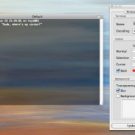
Figure 1: Invisible cursor

I’m a big fan of the popular Mac OS X terminal application iTerm, but for the first year or so of using it I was irked by a serious problem: my cursor was invisible! [Figure 1]

Figure 2: Visible cursor

I scoured high and low on the web and found other people reporting this problem but no one offering a solution.

I finally found the answer by accident a few months back and thought it was important to get it on the web somewhere so people can find it!

If you want to see your cursor in iTerm, for reasons completely unknown to me, you need to set its colours in reverse (that is, set the text colour to the background and the background colour to the foreground)! [Figure 2]

That’s all I wanted to say. I’ve never had any problems since. Happy iTerming!

Update: My good friend Paul has pointed me in the direction of the forthcoming iTerm2, for which I have just installed the beta. It looks like this addresses the issue above and also adds “Smart cursor color” which derives it from your other system colours. Hooray!

{lang: 'en-GB'}

Towards a Federal Europe

When asked for my national identity on the 2011 Census form, I put European. Why? Because I am not proud to be a member of this state, specifically, but I am very proud to be a citizen of Europe.

Europe, historically, has been at the forefront of technological and social evolution. Many of the world’s most important discoveries and inventions originated here, and many of our member states had huge empires to their name in the days when that was the done thing. But most importantly to me, we champion civil liberties before anywhere else. The abolition of the death penalty throughout the Council of Europe (of which the EU is a subset) and the advancement of LGBT rights are the two that come to mind immediately.

If the EU is treated as a single federal nation, it will become the richest in the world (32% of Earth’s GDP), while holding onto the third largest population (half a billion people, or 7% of Earth). In short, we’d be unstoppable.

The European Union already has a lot in common with federal nations like the United States, India and (recursively) Germany. We have a central parliament and high court which, like the United States, only has jurisdiction over certain aspects of the law. We have a single currency although many states have not yet adopted it. And we have some forms of common home policymaking (the European Commission) and foreign policy (CSDP and Eurofor).

So what’s missing? Why isn’t Europe considered a nation right now? Primarily this is because the individual states refuse to give up their sovereignty — something which will be very hard to pry away from many of them (especially the UK) with their long-standing traditions of empire-building and patriotism. Also required would be some form of written or unwritten constitution (which is an ongoing battle) and a single taxation system contributing to a federal exchequer. I don’t think these two are completely unrealistic long-term goals.

As a reader you can probably think of several disadvantages and I’d like to share my opinions on several of those:

Culture and Language

We’re all from different cultures and speak different languages, say the patriots. Well, that’s true, but is that such an oddity in a large nation? In India, there are hundreds of languages, of which 29 have more than a million native speakers each! Some states in Europe such as Belgium and Malta already cope just fine with multiple languages being spoken natively. And, closer to home, you’d hardly expect too many similarities between the culture of Burnley and the culture of Brighton. Culturally speaking, on a global scale most European states are pretty aligned.

Holes in the land

Norway, Switzerland and the microstates have elected to stay out of the Union, leaving holes in the land. This is not unheard of either: San Marino and the Vatican are already enclosed by Italy. Lesotho is surrounded by South Africa. And if tribal sovereignty is not ignored, the United States is full of holes!

We’ve got a Queen

Well that is an interesting one. Several of the states of Europe do indeed have their own monarchs. In a federation this too is not unprecedented. The United Arab Emirates is a federation of seven states, each with its own monarch. There is no reason to sacrifice a monarchy for the sake of federation.

Foreign policy

Should we let the European bigwigs decide what we do or don’t do with regard to other nations? Two words: Tony. Blair. Enough said?

The Euro has failed

A single nation would need a single currency, and the Euro has not done so well in recent times, thanks to the market crashes in Greece and Ireland. But I say we would all be helping each other out in these situations regardless, because that’s what allies do. Why not make it official and give us no choice but to support the poorer states with money from the rich? After all, it might be our turn in 50 years’ time.

Europe is a continent

Actually, Europe is described as a continent purely because of our cultural heritage, so this is a sign that we should be better united. There is no geological basis for the European continent at all. Oh, and by the way, Australia and India each make up the bulk of their respective tectonic plates.

I think I’m very much a dreamer in this regard, and I don’t think we’ll see a truly United Europe in my lifetime, but I’m hoping the progress is towards a Federal Europe and not away from it.

Next stop: United Earth!

{lang: 'en-GB'}

British superheroes

I recently finished The Adventures of Sherlock Holmes (a volume comprising the first 13 short stories) and it occurred to me that Holmes is very much an early superhero.

He has immense powers of deduction and disguise, often baffling even the best police detectives (whom he frequently refers to as ‘imbeciles’) and uses those powers only to further the common good and not for his own personal profit. He also shows another superhero trait, that of recognizing the value of all human beings, even wrongdoers, often finding a way to secure their escape rather than face the corrupt justice system.

But Holmes makes a big deal out of his powers being no more than any person could do with the right application of brainpower. He and Watson frequently point out that he, in fact, knows very little about anything other than what is necessary to solve mysteries. He relies on his library to fill in all the gaps.

Holmes has a counterpart across the Atlantic: Batman. Batman is also a brilliant detective, and similarly hates to see people die, but his whole aura and ethos is built up around his own personal mystery and scary tough-guy demeanour.

“Nicer” American superheroes such as Superman still primarily seem to be about strength and physical powers (either by birthright or through technology) in order to bring about the feeling of “necessary force”. In order to be a hero in American comic-book mythology, one has to stand up to one’s enemies.

I was thinking about British superheroes, and the next one that obviously came to mind was the Doctor. The Doctor has the ability to travel through time and space, and several centuries of knowledge built up from his endless fascination with science and technology. People all over the universe fear him, but he hates violence and does whatever he can to stop people from even giving each other dirty looks. His character, like Holmes, is that of someone who knows he has power and can’t help but use it for good, but because it’s fun, not because it’s right.

I had a search for British superheroes and the one that repeatedly came up in searches was John Constantine. I don’t know much about him, but it seems he has superpowers and is almost embarrassed to use them. He wants to prove to his enemies that he can defeat them using his intellect alone.

Something all these British heroes have in common is that they value their own mental prowess well above their physical abilities, and they’re determined to show their enemies this is the case.

Racking my brains for an American superhero with the same outlook I only came up with Jean-Luc Picard. And they gave him a British accent.

{lang: 'en-GB'}

Verbal after-images

As a former denizen of Manchester, it gave me a warm memory, on returning to that metropolis the other day, to hear the familiar sound:

Caution! Bollards in motion!

It got me thinking, though. Ten months away from Manchester and that phrase — not just its words but its tempo, pitch and timbre — is still etched into my brain.

In the era of recorded sound, specific repeated recorded phrases can become mnemonic cues, much like specific street scenes or smells.1

How many of these are cues for you?

Stand clear of the closing doors.

Unexpected item in bagging area!

Would Inspector Sands please come to the communication room?

Kids and grown-ups love it so; the happy world of Haribo.

First TransPennine Express apologises for the late running of this service, and for the inconvenience this may cause you.

Baggage left unattended will be removed by the security services and may be destroyed!

Your call is being held in a queue and will be answered as soon as possible.

Add your own in the comments!


{lang: 'en-GB'}
  1. Been to Jorvik Viking Centre? Remember the smell? Of course you do. []

Reviews: Flaming Lips and Kate Bush

Another two albums to review today, both based around a “reinvention” theme, and both bought for me by my brother Jon for my birthday last weekend.

Flaming Lips et al. - The Dark Side of the Moon

(c) 2009 Warner Bros.

The Flaming Lips (et al.) – The Dark Side of the Moon

I know I’m a bit behind the curve here — this album came out about 18 months ago — but it has only just made it into my collection and it fits well with the theme.

For reasons known only to themselves, Oklahoma psychedelic nutters The Flaming Lips have teamed up with singer Wayne’s brother’s band Stardeath & White Dwarfs to record a complete end-to-end cover of Pink Floyd’s 1973 masterpiece The Dark Side of the Moon.

On a first listen to this, I was horrified! A band I respect had taken one of my favourite musical masterworks and turned it into something wholly different. Out have gone the intricate melodic guitar riffs, samples of ringing alarm clocks and Clare Torry’s infinitely influential wordless vocals on The Great Gig in the Sky and in come heavy two-tone effects-pedal-ridden riffs, klaxons and the vocoder screeching of electro-diva Peaches. My first feeling was that this wasn’t a tribute, it was a desecration.

But it was their version of On The Run that got me listening again. An instrumental in both its forms, the Lips had seized the opportunity to take only the basic themes from the original and to completely rework them into a modern piece that is clearly their own. A Variation on a Theme of Pink Floyd, if you will.

Then I quickly realized that this is exactly what they had done throughout. This album is not a tribute to Pink Floyd. It’s a 21st-century prog rock record, made by The Flaming Lips, that has the same words and chord progressions as its 1973 namesake. As soon as I was able to accept this album for what it was, I instantly began to enjoy it.

The heavy-rock sound of Breathe (which makes its classic reprise at the end of Time) is a particular favourite and, I must say despite the screeching, Peaches’s version of The Great Gig is very enjoyable; she’s obviously a massive fan of the original too, and this shines through. The decision to record all of the original interview samples from the record using veteran punk singer Henry Rollins was great too.

This is definitely not a five-star album, and die-hard fans of the original are going to be left very unimpressed. But stick with it and you’ll see it’s a bit of a gem in its own right.

Kate Bush - Director's Cut
(c) 2011 Fish People

Kate Bush – Director’s Cut

One thing you can never say about Kate Bush is that she’s unoriginal. In the last six years, she’s not been off recording new material; no, she’s been off recording old material.

Director’s Cut is Kate’s answer to her decades of disappointment with how her 1989 album The Sensual World and 1993′s The Red Shoes turned out. She’s taken her favourite tracks from each, and rerecorded them into a single album as a kind of director’s cut of the originals.

As a big fan of the original albums, it is hard for me to understand exactly why someone would go to all this effort, but Kate is known for her extreme perfectionism, and she has gone to great lengths to make sometimes-subtle-sometimes-radical changes to these tracks and their production.

The album opens with Flower of the Mountain, which is the new title for the track The Sensual World with its original lyrics restored. Because Kate’s original version borrowed heavily from James Joyce’s Ulysses, she was initially forced to change the lyrics but has now acquired the right to use the original words.

Highlights for me include the modernized rock sound of Lily and Rubberband Girl, both of which suffered from that late-80s-early-90s jangliness in their original forms, and the new versions of Song of Solomon and This Woman’s Work, which are only slightly but noticeably different from their original recordings.

On the other hand, she has taken my favourite track from this era, Moments of Pleasure, and stripped it right down from its original orchestral sound to just a piano and her voice. I understand why she’s done this — it’s a very intimate song and a full orchestra could (although not in my opinion) be seen to be taking away from some of the meaning — but the problem is that the undeniable sadness in her voice in the original — as she sings the names of people close to her who have died — is absent on the new recording. I know this is her intention: the song is supposed to remind listeners of all the happy times they shared with those they’d lost, but I liked having my heartstrings pulled!

I think a lot of Kate Bush fans will greet this album thinking “what’s the point?” But then, I think those people miss the whole ethos of this woman’s work. She makes music for herself, and for her son, and she invites us to join her.

{lang: 'en-GB'}