
My blog has something to tell you Rotating Header Image

May, 2011:

Review: Mercury Rev play Deserter’s Songs

On Friday night I was fortunate enough to see Mercury Rev performing their 1998 magnum opus Deserter’s Songs at Manchester’s spectacular Bridgewater Hall.

The Bridgewater Hall, for the unfamiliar, is a purpose-built concert venue designed for the amazing sound of Manchester’s Hallé orchestra. The building’s attention to acoustic detail is extraordinary; so much so that the whole building floats on a foundation of 300 giant springs in order to separate its acoustics from those of the street outside. You can hear the difference: this is the first time I have seen a pop music act play at the venue, and it is possible to discern every note of every instrument as though you are sitting right next to it! The building only has trouble with vocals, which are still as clear as in any other music venue I have been.

The band were supported by ChameleonsVox – actually the classic Manchester post-punk band The Chameleons, renamed to reflect that only the vocalist and drummer remain from the original lineup. I was unfamiliar with their music but very impressed: it sounded like a sort of proto-post-rock, with heavy emphasis on the interactions between multiple guitar instruments and the drums, much like contemporary bands such as Explosions in the Sky. I reckon they could have done without the singer at all, however, who seemed to be a relic of a bygone age when bands like this needed vocals to sell records.

What was extremely surprising about the support was Mercury Rev singer Jonathan Donahue’s revelation partway through the main set that The Chameleons were the band he wanted to be in as a teenager; the band whose music got him through the bad times of his childhood. He expressed hope that Deserter’s Songs is the record that has done this for others in the audience, knowing full well that it has.

Mercury Rev’s main set was, of course, Deserter’s Songs in its entirety and in order. It’s an album I know inside out from many hundreds of listens in the last decade and a bit. Absolute highlights included opener Holes, an extended instrumental ending to Opus 40 and Donahue’s brilliant saw playing on instrumental Pick Up If You’re There. Even avant-garde throwaway track I Collect Coins sounded extraordinary live, although you could tell the band had put some effort into making it so. The only slight disappointment was Hudson Line, which recorded is very dependent on instruments to which the band had no access live.

Speaking of instrumentation, it deserves a special mention. The Rev’s unique sound is characterized by having two keyboard players, who typically set their instruments to different voices producing a huge array of different instrumental experiences. The sound is rounded off by traditional rock instruments, including Donahue himself adding an additional guitar for many tracks, reminding us that this was once his forte when he was guitarist for the Flaming Lips in the late 1980s.

Most disappointing was the audience reaction. Seated gigs are rarely animated, but you’d think some people would get shifting in their seats during a song called Delta Sun Bottleneck Stomp! The band received a standing ovation at the end of their main set and their encore, however, so the audience must have loved it even in their slightly subdued way.

The encore consisted of an animated, happy, cover of Peter Gabriel’s Solsbury Hill, early single Car Wash Hair, 2001′s The Dark Is Rising (Donahue’s on-stage actions exactly mirroring those from when I saw the band touring that album) and finally their new live finisher Senses On Fire, which does exactly what it says on the tin. A great way to finish off a great evening: a five-star performance.

{lang: 'en-GB'}

Fascism, immigration and the English language

The BNP and other right-wing groups I loosely term fascist (although some may, legitimately, disagree with my use of the term) are always talking about making sure Britain stays “British”, and keeping its population “indigenous” so that our culture is not polluted by those of the immigrant nations.

Here’s a representative quote from the BNP web site1:

Immigration is out of control. Britain’s population is now over 60 million and rising, solely due to immigration. Not only is Britain increasingly overcrowded, but the fact is that a country is the product of its people and if you change the people you inevitably change the nature of the country.

We want Britain to remain – or return to – the way it has traditionally been. We accept that Britain always will have ethnic minorities and have no problem with this as long as they remain minorities and do not change nor seek to change the fundamental culture and identity of the indigenous peoples of the British Isles.

Now, without being too pedantic about the rest of this, let’s focus on the word indigenous. Wikipedia defines this well:

Indigenous peoples are ethnic groups who are native to a land or region, especially before the arrival and intrusion of a foreign and possibly dominating culture.

Well, I guess the race with the biggest claim to that is the Celts. They arrived here in the Bronze Age, around 1200 BC, and thrived throughout the Iron Age and throughout the Roman subjugation of England and Wales. They spoke a group of languages known as British, which survive in the modern forms of Irish, Scottish Gaelic, Welsh and Cornish.

However, I believe Mr Griffin is also referring to the aforementioned “foreign and possibly dominating culture”: the Anglo-Saxons. Anglo-Saxons make up by far the largest ethnic group in Britain, and indeed Mr Griffin himself is one. But they are far from indigenous to these islands. The first Anglo-Saxons arrived here in Britain in the early 5th century, as mercenaries hired by the failing Roman occupiers. In 442 AD they mutinied and eventually took the land for themselves at the turn of the 6th century.

In case you missed this: even the Romans have more of a claim to being the indigenous peoples of this island than the Anglo-Saxons!

The Word Tree at Ellis Island Museum of Immigration, showcasing words brought into American English by immigrants and natives

The Anglo-Saxons brought with them an exciting new language, called English. What is exciting about English is that it is a true language of immigrants. It has shaped itself repeatedly as it has been used in more and more parts of the world. It has taken concepts and words from virtually every culture on the Earth. English has been adopted by so many people as the language of international commerce and travel, thanks to its willingness to open up to foreign influences.

The English we speak today still has broadly the same grammar as its closest relatives, the Germanic languages, but a staggering 58% of the English lexicon is borrowed from Latin and French alone, neither of which have even made a dent in the other Germanic languages.

As an example of how quickly English allows itself to change and adapt to foreign influences, here’s the opening of Beowulf, an English-language poem written less time ago than the time between the arrival of the Celts and the arrival of the Anglo-Saxons:

Hwæt! W? G?r?Dena in ge?r?dagum
þ?od?cyninga þrym gefr?non,
h? þ? æðelingas ellen fremedon.
Oft Scyld Sc?fing sceaðena þr?atum,
monegum m?gðum meodo?setla oft?ah.
Egsode eorl, syððan ?rest wearð
f?a?sceaft funden: h? þæs fr?fre geb?d,
w?ox under wolcnum, weorð?myndum ð?h,
oð þæt him ?ghwylc þ?ra ymb?sittendra
ofer hron?r?de h?ran scolde,
gomban gyldan: þæt wæs g?d cyning!

Know what it’s on about? If you do, you beat me!

So, for fun, let’s pick languages from some ethnic groups commonly picked on by the BNP and its ilk, and have a think about how Mr Griffin and co. would get along without some of these apparently very English words:

  • Arabic: admiral, coffee, guitar, lemon, magazine, orange, sofa, zero.
  • Chinese: ketchup, silk, tea, tycoon.
  • Hebrew2: apron, cannon, cider, map, sapphire.
  • Hindi/Urdu: bungalow, jungle, pyjamas, shampoo, thug.
  • Persian/Farsi: cash, magic, peach, tiger.
  • Slavic languages: bridge (the game), robot, vampire.
  • Turkish: bugger, doodle, kiosk, yoghurt.

And, as an interesting aside, loanwords from the indigenous languages of these islands are extremely rare in our language. 3

{lang: 'en-GB'}
  1. I hesitate to link for fear of increasing their Google PageRank. []
  2. Yes, yes, I know the BNP has explicitly stated many times it’s not anti-Semitic, but many right-wing groups are! []
  3. Although it is believed that penguin comes from the Welsh for “white head”. Yes, penguins have black heads. []

I’m not stupid, but: what is https about?
Any tech-geek followers of my blog will probably know this inside out, so this one is for the rest of you.

My next entry in the I’m not stupid, but… series is about the difference between http and https in web URLs. We’re all told https is more secure, but there’s a shroud of mystery about what this actually means.

In a nutshell:

  • https prevents anyone but you and the owner of the web site reading your communications.
  • At a public internet connection, not using https means anyone in that same location can steal your login sessions at any sites you visit while there.
  • The certificate proves the owner of the site you are visiting is who they say they are.

When you visit a web site, you are communicating with a computer somewhere else in the world in a language called HTTP. This communication, like all internet traffic, is a bit like sending a letter in the post. The data you send travels from router to router much like a letter travels from sorting office to sorting office until it arrives at its destination.

Just like in the mail, anyone in between you and the destination can open the envelope and read the data contained within. This data could be your username and password when filling in a form, or it could be data coming back from the site with, for example, your bank balance. Moreover, in order that you not have to log in to every page on a site, your browser will usually send something with each communication called an authentication cookie which proves you are already logged in.

The most dangerous place for this kind of information free-for-all is a shared internet connection, such as in a coffee shop. This is a bit like everyone sharing the same post box – when someone goes to put a letter in, they can reach out and grab yours along with it and read anything in it. This type of security breach is easily demonstrated with something called Firesheep, which displays the secret authentication cookies of anyone using non-https sites at the same location as the user and allows that person to steal these login sessions.

A URL beginning https means the HTTP is placed inside something called SSL. SSL is encrypted data: in the mail analogy it is like a special armoured envelope that can only be opened by the recipient to whom you have addressed it. The recipient can still do what he/she likes with the data but no one in between has access to it.

If the site has https for the login form, this will prevent people stealing your password, but if it then redirects you to a plain http site once you are logged in, you are still at risk because your browser is still sending the authentication cookie with every request and other users can use this to “prove” they are you.

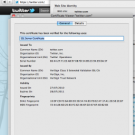
Example of certificate information

The final piece of this puzzle is the certificate.

When you visit a web site using https, the browser will look for proof that the site is who it is supposed to be (and not, for example, someone who has stolen the domain name or a rogue internet provider re-routing the traffic). The proof comes in the form of a digital certificate signed by a company that has done a quick background check on the company supposedly in charge of the site.

In the example illustrated, Twitter’s certificate is signed by VeriSign. Because your browser is pre-programmed to trust VeriSign (with its own signed certificate!), the chain of trust is complete.

If you visit a site with https that does not present a certificate, or the certificate is signed by someone your browser does not trust, you will be presented with a large warning advising you to be cautious before proceeding. When this happens, what your browser is telling you is that your data is still unable to be read by anyone except you and the owner of the site, but it can’t verify the owner of the site is who they say they are.

The warning is a bit scary, considering it is still safer than visiting a site using only http, where anyone can read your data and no background checks are done on the owner at all.

The moral of this tale is:

If you are ever logging into a service, and you value the data you are providing to that service, please ensure that service is using https URLs throughout.

Some sites, such as Twitter and Facebook, require you to enable this option in your settings, and it is very wise to do so. Many other sites simply do not support this. If you consider your data valuable, please write to the provider of the service, requesting that they enable this feature!

{lang: 'en-GB'}

Reviews: Guillemots and Fleet Foxes

© 2011 Geffen

Guillemots – Walk the River

The multi-national, multi-instrumentalist, multi-talented Guillemots have a lot to live up to. Their 2006 debut Through the Windowpane was a seminal masterpiece that proudly boasts my favourite song ever (São Paulo). The followup EP Of the Night and subsequent album Red showcased the whole band’s songwriting and experimentation with every popular music style under the sun, alienating most of their fanbase in the process but creating a smorgasbord record with great repeat-listen value for those of us who chose to stick with it. Lead singer Fyfe’s solo album made him a brief bigtime personality when his Billy Joel cover was used on a John Lewis advert that made the nation cry.

The new offering, Walk the River, takes the multi-genre hotchpotch of Red and applies a more consistent formula of darkness and sadness marked by Fyfe’s powerful and dark lyrics. The album speeds up and slows down, swells and mellows, makes you move your feet and makes you drift into meditation, but nevertheless throughout it feels like they’re all components of one longer consistent work, which is what you want from an album. Experienced critics would use terms like “mature sound” here.

As usual, the real talent in Guillemots’ music is the instrumentation, and this album might be the best yet. Just try to pick out how many instruments are used in seemingly-simple-at-first opener Walk the River, or listen to the slowly building sound of nine-minute epic Sometimes I Remember Wrong to see what I mean.

This album is not going to be a hit, and is unlikely to be remembered as a modern classic like their debut, but it’s a powerful, consistent and experimental work and it’s been on my playlist solidly since its release.

© 2011 Bella Union

Fleet Foxes – Helplessness Blues

Seattle’s Fleet Foxes have been an unexpected huge success in the UK ever since they first appeared on the scene in 2008. Their brand of 60s-style folk rock with a modern twist was an instant hit with young and old music fans alike.

On first listen, Helplessness Blues sounds like more of the same, and certainly the fans lapped it up — it went straight to #2 in the charts. More of the same would have been fun but ultimately kind of boring, like a bonus disc to the first album.1

But this album is different. OK, there are classic Foxes sounds like beautiful lead single Helplessness Blues, but then we see things like the Eastern-inspired high-speed guitaring at the end of Sim Sala Bim and what can only be described as folk rock opera in the form of eight-minute The Shrine/An Argument, easily the standout track on the album after a few listens. Hell, they even drop the medieval vocal harmonies on a track or two!

This second offering from our beloved Foxes is the sound of a band that knows it’s already found its niche, but is successfully spreading its wings within that space looking for the perfect sound. I can’t wait for number three!

{lang: 'en-GB'}
  1. Yes, I know, we had one of those already and it was awesome. []

I’m not stupid, but: what’s the difference between envy and jealousy?

I thought since I’m known the world over as a pedantic git and someone who has an unrelenting desire to share crateloads of useless knowledge with everyone he meets, I’d start this series on my blog that I call I’m not stupid, but…

In this series I try to explain those things that I’ve encountered that are very simple to understand but for some reason it took me some years to grasp, perhaps because no one bothered to teach me about them, in school or otherwise.

I’ll start with one of my favourites, because once you know this, you’ll see the mistake everywhere and (if you’re like me) constantly have to fight the urge to correct people. I’ve noticed, also, that many novels contain passages that highlight this difference in such a blatant way that it is almost as if the author is saying “Shit! I never knew that! I must prove to people that I know it now!”

What is the difference between envy and jealousy? It’s pretty straightforward:

  • Envy is the desire to have that which your neighbour possesses.
  • Jealousy is the fear of your neighbour taking that which you possess.

If you see your friend playing with her iPad, and you find yourself thinking “I wish I had a 10-inch Angry Birds machine!” then you are green with envy. You are coveting your neighbour’s possession.

If you get scared or panicky when someone in your workplace excels at something you are paid to do, you are jealous of that person. You fear your neighbour will take your job. In modern contexts, jealousy almost always refers to a fear of losing a romantic partner or a job to someone else, because of a perceived “betterness”.

Join me next time for another exciting installment!

{lang: 'en-GB'}

NHS dentists; or, how I learned to start worrying and hate my teeth

I’ve just come back from having the second of two fillings put in at my new dentist. Why did I need two fillings, you ask? Well, this dentist is the first dentist I’d visited in over ten years.

Why did I stay away for so long? I’m not really the squeamish type: I don’t have a problem with jabs, blood tests and so forth… I went ahead with a circumcision given an on-the-spot choice about having it that day, for heaven’s sake. No, I stayed away because the NHS dental system itself set the ball rolling on the cumulative fear process.

The cumulative fear process, as I call it, is that process that occurs when you put something off because you’re scared of it, but the longer you put it off, the scarier it becomes, which of course makes it harder to go through with.

I wasn’t scared in the beginning, though. I was merely baffled and intimidated by the system. That was enough to keep me away long enough to start rolling up the katamari of fear.

The thing is: NHS dentistry costs money, and it is only accessible to a lucky few.

More or less everything else on the NHS costs the patient nothing. This even includes scientifically unproven so-called complementary therapies like acupuncture and homeopathy. Not so dentistry: working adults over the age of 18 and students over the age of 19 are asked to make a contribution of normally £47 (but possibly £204) for any treatment, and £17 for a checkup or hygiene appointment.

As a student at the age of 19 that’s not a fun prospect. We’re not only mostly not earning at that age, we’re also living off borrowed money, and very little of that. £47 back then would have been a week’s rent and still is for many students.

But that’s only a small part of the problem most people face when they become students. Many of us chose to obey the so-called “hundred-mile rule”1 which meant we were too far from our family dentists to return to them every time we needed a checkup or, worse, a course of treatment.

So that leaves us to find a new NHS dentist. But where are they? The NHS choices web site will tell us there are hundreds of dentists registered with the NHS, but are they accepting new NHS patients? Are they bollocks.

Finding an NHS dentist that’s accepting patients in a city centre is a bit like winning a few hundred quid on the lottery. You’ve met people who’ve done it, but you know it’ll never happen to you. I had a look in Leeds and the closest one I could find was a good 30 minutes’ walk from my city centre flat and oh my was it scary… The reception staff were sat inside their little box behind a code-locked door, the surgery itself was nowhere to be seen and the shockingly sparse waiting room was plastered in “patients who sneeze will be shot”-type signs. I ran.

It took a serious bout of gingivitis to get me to book in to see a dentist. I signed on with my work’s optional dental insurance and got myself registered with an awesome private dentist that only charges about double the NHS prices for simple treatment.2 I’m lucky my employer gives me dental insurance, but few if any other people I know are so fortunate.

So what can we do to give people more opportunity to register with NHS dentists, and to give those who are not earning a chance to continue receiving a vital healthcare service for nothing? I don’t know, but I’m certain that the current government with its supposed “We love the NHS” reforms is not going to help us get there.

{lang: 'en-GB'}
  1. A university roughly a hundred miles away is close enough to bother your parents for food parcels but not close enough for them to drop in unexpectedly. []
  2. City Dental, if you’re interested. []

New York photos

I know it’s been over two months since I got back from New York, but I’ve just got round to post-processing my favourite 32 out of 2000+ photos I took when I was there.

Hope you enjoy them!

New York photo set

{lang: 'en-GB'}

Agile Manifesto poster

Beware: 1.7MB image

As a software engineer & manager, I’m a massive fan of the principles of Agile software development, as embodied in the Agile Manifesto.

I really believe software development and the interaction between software development companies and their customers would be radically different if more people adopted these four basic values and twelve basic principles.

But, somewhere in recent history, the word Agile has been hijacked by big companies and transformed into a synonym for iterative development. Now, while I’m a great believer in iterative development, it only works if it’s accompanied by the other principles of Agile development.

Principles that are often ignored by big-business management include:

Build projects around motivated individuals. Give them the environment and support they need, and trust them to get the job done.

and

The best architectures, requirements, and designs emerge from self-organizing teams.

This sort of management interference has eroded the Agile concept so much that a search on Google for “Agile poster” turns up many instances of this monstrosity and many like it. Doesn’t really line up with the following principle, now, does it?

Simplicity — the art of maximizing the amount of work not done — is essential.

I searched high and low for a decent poster representing the Agile Manifesto and found not one.

So I made one. Specifically, I made one as a leaving present to give to my previous employer, who held the bastardized version of Agile development in such high regard.

If you work in the software industry and you’ve been exposed to poor development processes, do yourself and your employer a favour: Print this out. Put it on your wall at work. Make people think, and remind them that there is a better way to work.

Update: It looks like, in the time since I designed this poster and gave it to my former employer back in July 2010, the folks at DZone have had a similar idea. Good for them!

{lang: 'en-GB'}

Why is bin Laden dead?

So. Osama bin Laden is dead. I think we’ve all noticed that by now.

Thankfully some of the media and public figures have started to decry the celebration and chanting following his death. It is still the death of a human being and this is not cause for jubilation.

What I’m more concerned about, however, is why he’s dead at all. We’re told there was a “firefight” and that “no Americans were harmed”. We’re also told that he “tried to hide behind women”. This doesn’t sound like an all-out battle to the death to me. It sounds like they cornered him and then killed him anyway.

There’s a name for this: summary execution. It’s illegal under the Geneva/Hague Conventions. And with good reason: killing someone without trial is a violation of fundamental human rights, even if the trial would be an open-and-shut case. It is, and never should be, the prerogative of an army soldier or his/her commanding officer to decide whether a war criminal should die. The days of “Wanted: Dead or Alive” should be long behind us.

And, of course, the death in combat circumstances of a powerful figurehead turns that person into a martyr. Osama bin Laden will never be put on trial for what he has done and so extremists the world over will be forced to make their own minds up. Great.

Now, in recent hours we’ve been told by US counter-terrorism chief John Brennan that “if we would have been able to take him alive, we would have done that”. Is that so? Even though not one of the US soldiers was harmed and the only other casualty was one of bin Laden’s wives that he used as a human shield? Then let’s hear more about why it was necessary to kill bin Laden, rather than merely disabling and capturing him.

It certainly doesn’t sound like it was a fair (read: legal) fight from where I’m standing.

{lang: 'en-GB'}

The Yes vote needs you!

The opinion polls are showing the “No” vote in the upcoming referendum on whether to adopt AV for parliamentary elections as being a dead cert. The “Yes” campaign needs as many votes as it can possibly get!

Please get to a polling station on 5th May and cast your vote. Don’t waste it because you think the voting system doesn’t matter.

Here are the reasons you should vote “Yes”, in a nutshell:

  • Under the current system, an MP can be elected when a huge majority of the voting population votes against that candidate. Here’s a perfect example using beer and coffee to illustrate this. In a real decision-making situation like this, people would say “well, 70% of us want beer so let’s pick the pub we most agree on”.
  • Under the current system, a vote for the candidate of your choice can be considered a “wasted” vote, because by voting for your favourite candidate from a non-major political party you are surrendering your right to decide which of the major political parties you prefer. This illustration of someone going out to buy you sweets is perfect.
  • The BNP are opposing the “Yes” campaign because it would likely not give them an advantage. But if it does give the will of the people the chance to elect BNP representatives, shouldn’t that be allowed? This is supposed to be a democracy, after all.

Please, please, please, get out and vote on 5th May. This is important and it will change politics for the better if it happens!

{lang: 'en-GB'}